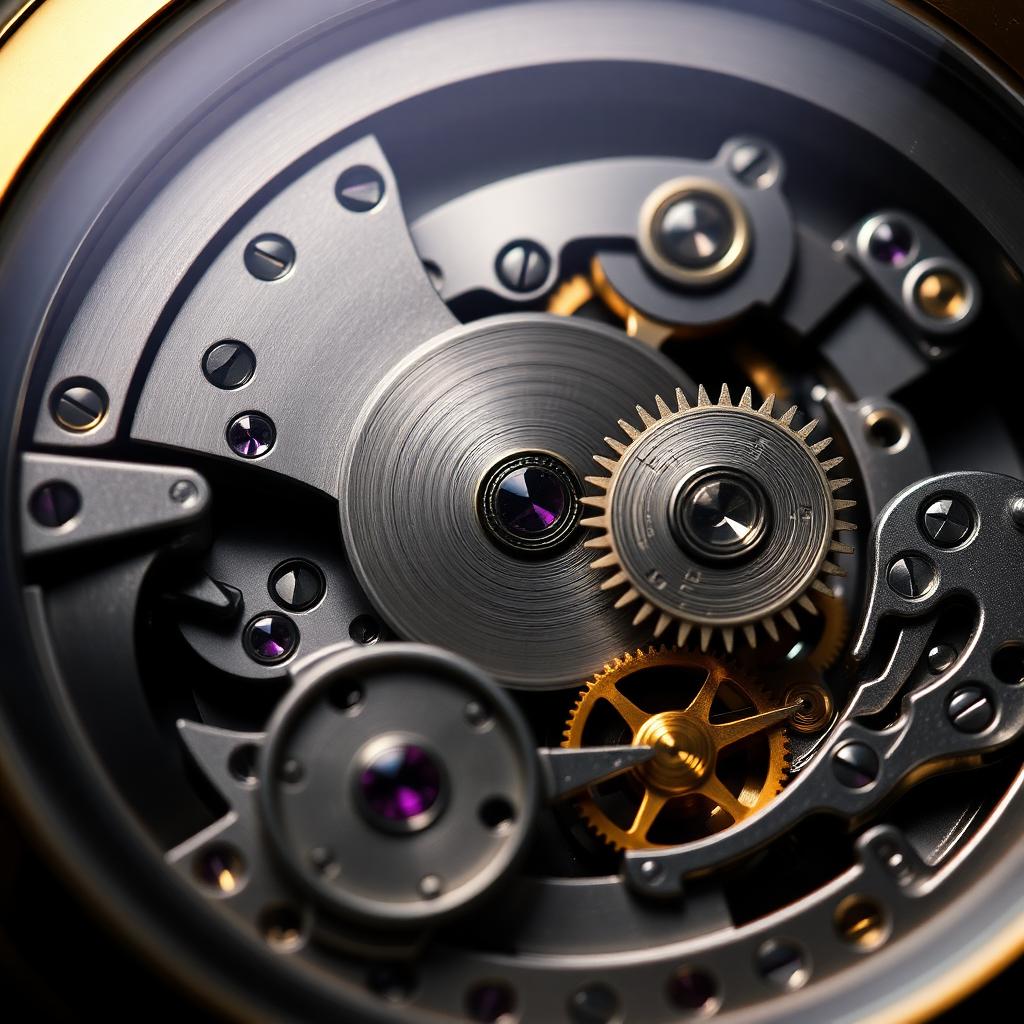
Quartz ±15 sec / month Battery-powered precision.
A small battery sends current through a quartz crystal, which oscillates 32,768 times per second. A circuit converts the pulses into one tick per second.
Pros
+ Extremely accurate + Affordable + Low maintenance Cons
− Battery changes − Lacks mechanical romance
Automatic −4 / +6 sec / day (COSC) Wound by your wrist.
A weighted rotor swings with wrist motion, winding the mainspring. Stored energy flows through gears to the escapement, which releases it in precise beats.
Pros
+ No battery + Self-winding + Mechanical craft Cons
− Needs servicing − Less accurate than quartz
Manual Wind ±5–10 sec / day A daily ritual.
Turning the crown winds the mainspring directly. There is no rotor, so the movement can be thinner, a favorite for dress watches.
Pros
+ Thin profile + Direct connection + Pure mechanics Cons
− Must be wound regularly − No power if forgotten
Tourbillon ±2 sec / day (top tier) Gravity, defeated.
Invented by Breguet in 1801, the tourbillon places the escapement and balance wheel inside a rotating cage to average out gravity's effects on accuracy.
Pros
+ Mechanical artistry + Improved accuracy in pocket era + Status symbol Cons
− Extremely expensive − Marginal benefit on wrist
Chronometer −4 / +6 sec / day Certified precision.
Not a movement type but a rating. A chronometer has passed COSC's 15-day, multi-position, multi-temperature accuracy test.
Pros
+ Verified accuracy + Quality assurance Cons
− Adds cost − Not all good movements bother
Spring Drive ±1 sec / day Mechanical heart, quartz brain.
Seiko's hybrid winds like an automatic but regulates with a tri-synchro tuned by a quartz oscillator. The seconds hand glides without ticking.
Pros
+ ±1 sec/day accuracy + Glide motion seconds + No battery Cons
− Proprietary to Seiko/Grand Seiko − Costly